
The first Beef Wellington I ever served was for a holiday dinner I'd talked up for weeks. It came out of the oven looking magnificent — bronze, glossy, the whole table went quiet. Then I cut into it, and a little tide of grey juice ran across the board, the bottom crust had gone to paste, and the beef was closer to well-done than the blushing pink I'd promised. I smiled through dinner. Then I went back and figured out exactly where it had gone wrong.
Here's what fifteen years and a lot of Wellingtons since have taught me: this dish has a reputation for being temperamental, but it isn't fussy so much as it is a sequence. Nearly every failure I've had — and I've had all of them — traces back to one of three things: a wet filling, a warm assembly, or a guessed temperature. Get those three right and a Wellington is genuinely hard to ruin. Let me walk you through it the way I actually teach it.
What exactly is a Beef Wellington?
A Beef Wellington is a whole beef tenderloin, seared and then wrapped in layers — a savory mushroom paste, a sheet of prosciutto, sometimes a thin crêpe — and finally sealed in puff pastry and baked until deep golden. Each layer is doing a job. There's flavor, yes, but mostly those layers are a defense system against the one thing that ruins this dish: moisture.
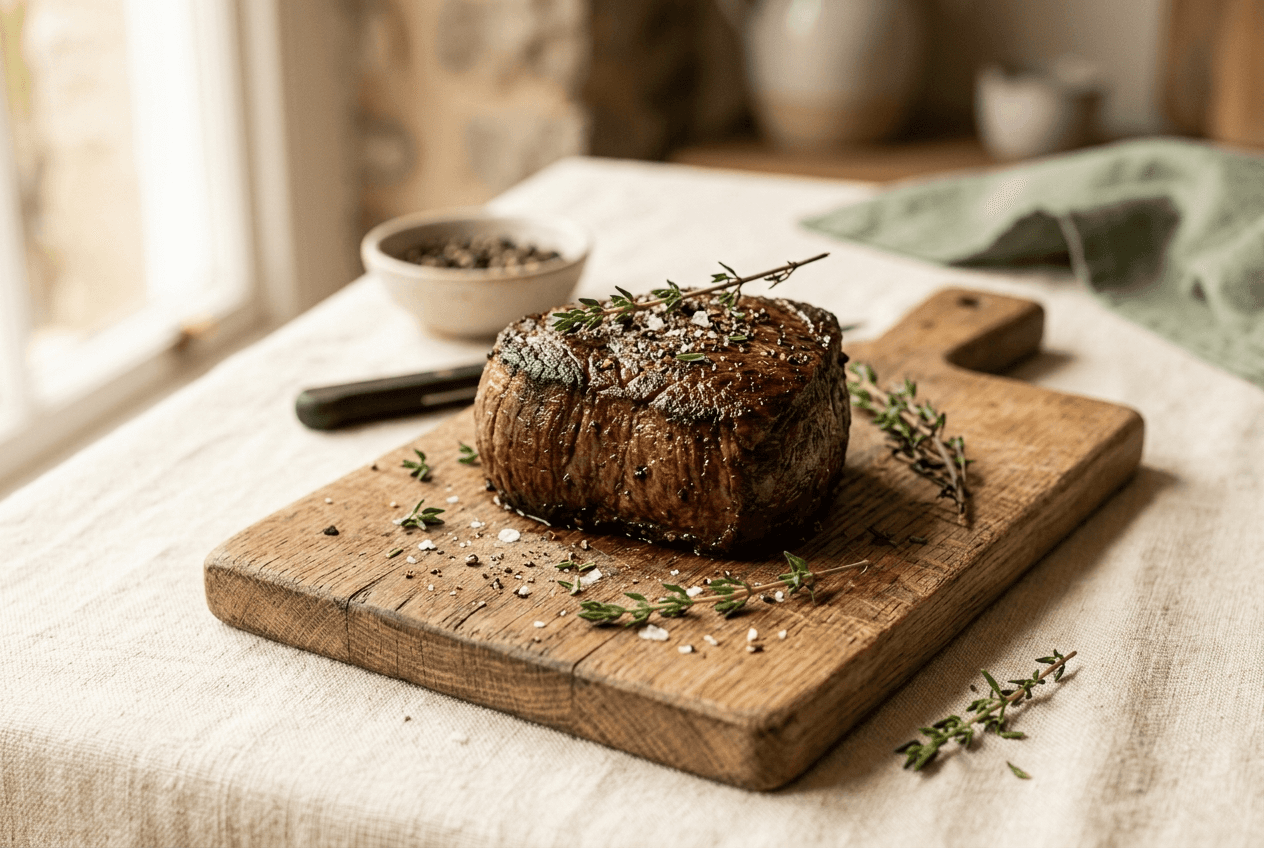
It starts with a hard sear — a deep crust now means a rosy center later.
Why does Beef Wellington go soggy on the bottom?
Because beef and mushrooms are both full of water, and a hot oven pulls it right out. The juices weeping from the meat and the steam escaping the mushrooms have nowhere to go but down — into the pastry sitting underneath. That's the soggy bottom everyone warns you about, and it's completely preventable once you know it's a plumbing problem, not a baking one.
The fix isn't one trick — it's a series of small barriers. We dry the mushrooms out completely. We sear and chill the beef so it isn't shedding juice. We wrap it in prosciutto to catch what's left. And we bake on a screaming-hot tray so the base of the pastry sets before any moisture can soak in.
The mushroom duxelles — your first line of defense
Duxelles is just mushrooms, shallots, and a little thyme cooked down to a dark, concentrated paste. It's where most Wellingtons are won or lost, because if those mushrooms go in even slightly wet, your crust doesn't stand a chance.
Pulse mushrooms in a food processor until finely chopped — not puréed. Cook them in a dry-ish pan over medium heat, and keep going past the point you think they're done. They'll release a startling amount of water, then sizzle, then go glossy and dark and start to clump. That's the cue. If you're at all unsure, press the cooked duxelles between paper towels. Then let it cool completely before it touches the beef.
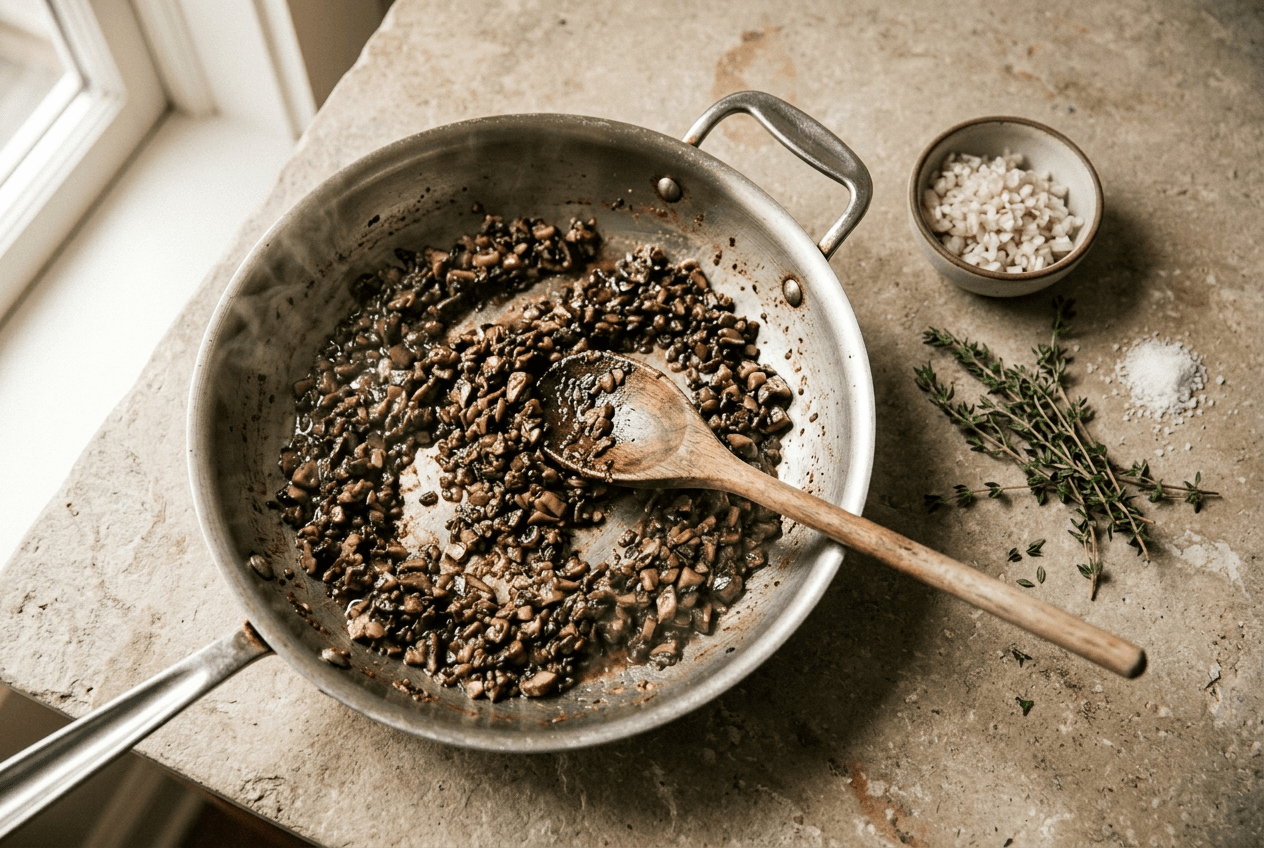
Cook the duxelles well past "looks done" — until it's dark, glossy, and dry to the touch.
How do you assemble a Beef Wellington that holds together?
Assembly is all about temperature and tension: everything cold, everything wrapped tight. Here's the order I use.
- Pat the tenderloin bone-dry, season it, and sear hard in a rip-hot pan until deeply browned on every side. Don't cook it through — you're building crust, not doneness. Cool it, then chill.
- Lay a large sheet of plastic wrap down and spread the cooled duxelles over it in an even layer.
- Shingle the prosciutto over the duxelles so it slightly overlaps — this is your moisture barrier. (A thin crêpe under the duxelles is the classic restaurant move if you want belt-and-suspenders insurance.)
- Set the chilled beef on the edge and use the plastic wrap to roll it into a tight cylinder, twisting the ends like a candy wrapper. Chill 20–30 minutes so it holds its shape.
- Unwrap onto a sheet of cold puff pastry, roll it up, seal the seam and ends, and trim the excess. Flip it seam-side down.
- Egg wash, score the top lightly for decoration, and cut a couple of small steam vents. Chill again until the oven is hot.
That cross-section — beef at the center, then prosciutto, then dry duxelles, then crisp pastry — isn't just pretty. Every ring is there to keep the next one dry.
What temperature should Beef Wellington be?
This is the part people guess at, and guessing is exactly how you end up with grey, overcooked beef inside a beautiful crust. You can't see the meat, so you have to measure it. An instant-read thermometer pushed into the very center is the whole game.
Bake in a hot oven — around 400°F (200°C) — until the pastry is deep golden and the center hits your target. The important trick: a Wellington keeps cooking under its insulating pastry even after it comes out, so pull it about 10°F before your goal and let it rest a full 10 minutes before slicing. Rest it on a rack, not a plate, so the base stays crisp.
Rest matters as much as the number. Slice too soon and the juices you worked so hard to keep inside will run straight out onto the board.

This is the payoff: crisp golden pastry, a clean mushroom-and-prosciutto ring, and a rosy center.
The little things that trip people up
- Wet anything. Damp duxelles, a warm just-seared roast, condensation on the pastry — water is the enemy at every stage. When in doubt, blot and chill.
- A warm kitchen and warm hands. Puff pastry is built on cold butter. If it gets soft and greasy while you work, it won't puff — pop everything back in the fridge and reset.
- Guessing the temperature. A $10 instant-read thermometer is the difference between rosy and ruined. Don't cook this dish without one.
- Skipping the rest. Ten minutes feels like forever when it smells that good. Cut early and you'll watch all that juice spill out anyway.
- Forgetting the steam vents. Trapped steam softens pastry from the inside. A couple of small slits let it escape.
A Beef Wellington isn't a hard dish — it's a patient one. Dry your mushrooms, keep everything cold, trust your thermometer, and let it rest before you cut. Do that, and you'll set down the kind of centerpiece that makes a table go quiet for the right reasons. And if your first one weeps a little? Mine did too. Make another. That's the whole secret.